

Hedgelaying: The Ancient Art of Building a Fence That Grows
Take a young tree. Cut it almost all the way through. Bend it over. Then watch it carry on growing as if nothing happened.
It sounds like a magic trick, and it’s one of the oldest jobs in the British countryside. Here on our organic farm near Welshpool, it’s also one of our favourite ways to spend a frosty winter morning. Here’s what hedgelaying is, where it came from, why Welsh hedgers do it differently, and why we think more people should learn it.
What is hedgelaying?
Leave a hedge alone long enough and it stops being a hedge. It turns into a row of skinny trees where any ewe worth her wool will find the gap before you do.
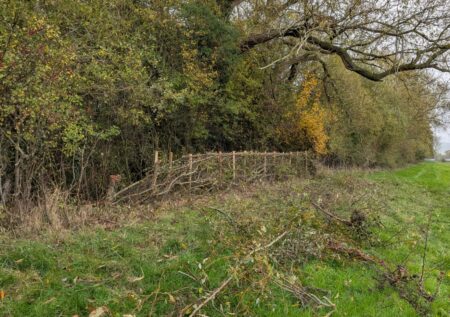
Hedgelaying puts the hedge back to work. The method is simple, but it takes skill to do well:
- Cut. Each upright stem is cut most of the way through, close to the ground. A strip of bark and sapwood is left as a hinge, so the stem remains attached to its roots and stays alive.
- Bend. The stem is laid over at an angle along the line of the hedge, which hedgers call a “pleacher”.
- Weave. Stakes go in at intervals and the pleachers are woven between them. The twiggy growth, known as brash, is trimmed and tucked in.
- Bind. In many styles, long hazel rods are twisted along the top of the stakes to lock it all together. These are called binders, or in parts of Wales, hetherings.
Museum Wales calls the result “effectively a living fence” (Museum Wales). Come spring, the cut stumps (aka stools) produce fresh shoots. And within a few years, the bottom of the hedge is thick enough to stop even the most cunning livestock.
A job for winter, and not every winter
Hedgelaying is winter work, done when the leaves are off, the sap is down, and the plants will bounce back best. It also isn’t an annual chore. A hedge needs to be at least 3 metres tall (ideally 4) before it’s worth laying (Hedgelink). After that, it usually takes 8 to 15 years of regrowth before it’s ready to lay again, and often longer. A hedge you lay this winter could still be doing its job when your grandchildren are tottering about!
The traditional kit is a billhook and an axe, but it’s common for hedgers to bring a chainsaw for the bigger stems, especially when contracting or in competitions that allow them.
A short history of British hedges
From Roman legions to Welsh fields
The earliest written account of woven hedges comes from Julius Caesar, who described them in his Gallic War. Clearly hedges impressed people enough to get a mention in the middle of a military campaign.
In Wales, open land was steadily enclosed into fields from the 16th century onwards. Hedges beat stone walls on cost, and they did several jobs at once: they kept stock from wandering, gave shelter, and produced food for people and animals alike.
The great grubbing-out
After the Second World War, things went downhill fast. The Agriculture Act 1947 paid farmers to remove hedges, and around half of Britain’s hedgerows were lost between the 1940s and 1990s, mostly in England (UKCEH).
Hunting estates played a surprisingly vital role in keeping hedgelaying alive during its leanest years. The craft gained formal protection in 1978 with the founding of the National Hedgelaying Society (NHLS). Today, the society is under the patronage of King Charles III, who fondly admits to trying his hand at laying hedges “myself after a fashion.”
The many styles of hedgelaying
Why is every region different?
Hedgers once worked within about five miles of home. Each district settled on its own way of doing things, shaped by the stock it kept and whatever happened to grow in its hedges. The result is a patchwork of around a dozen regional styles recognised by the NHLS today.
Just over the border in England, the Midland style was built for cattle and horses. It’s brushed on one side only, because a cow leans on a hedge and pushes, and one solid face to increase space for crops and stop growth encroaching on arable land.
Welsh hedges are built for sheep
Welsh styles answer a different question: how do you stop a sheep? Sheep browse and push low on a hedgeline, so Welsh hedgers usually leave the brash on both sides of the hedge (“double brush”). They also pack it with dead wood, so sheep can’t destroy the tender new shoots.
The NHLS quotes the old test for any Welsh hedge: can it “stop a Welsh mountain ewe and two lambs in March”? If you’ve ever kept hill sheep, you’ll know that’s a high bar. Welsh Mountain ewes treat fences as a challenge, not a boundary.
Montgomeryshire style: our home style
Here in Welshpool, the Montgomeryshire style is the local tradition. It’s double brush, with a bushy “face” and a stronger, stockproof “back”. Stakes go in about 45 cm apart. Instead of binding the top with hazel rods, a Montgomeryshire hedger plaits it, laying long branches in behind one stake and around the next.
The finished hedge stands about 3ft 6in tall, roughly 1m, on a base 18 inches to 2 feet wide (NHLS). Stake-and-pleach work is recorded across Montgomeryshire, as well as Brecknockshire, Radnorshire and Carmarthenshire styles.
Welsh Border style: our favourite style
Welshpool sits just a few miles from the border, so the Welsh Border style is a close neighbour. It’s also double brush, but you can spot it a field away by its sloping stakes. In the competition version, stakes are driven in 75 cm apart at an angle of 35° which is unique to Welsh hedgelaying. The slope is said to shed rainwater away from the stools so they don’t rot.
Further south you’ll find the Brecon style and the low, bank-top “flying hedge” of Pembrokeshire and Gower.
Why laid hedges matter
The real problem now: neglect
Countryside surveys in Wales have recorded less managed hedgerow since 1984, and more hedges left to grow into straggly lines of trees and shrubs. In July 2025 the Welsh Government admitted that “many of our hedgerows are not faring well” (GOV.WALES).
Hedges tend to fail in one of two ways:
- Trimmed to the same line every year, the base goes gnarled and gappy until you’re left with a row of mushroom-shaped bushes. Machine trimming is now the usual way hedges are kept, so it’s a common sight.
- Left alone entirely, the hedge grows up into a line of trees with nothing underneath.
Laying resets both. In one field trial, laid and coppiced hedges were dramatically denser at the base after just three years. Their biggest gaps were under 30 cm², smaller than a bank card. Untreated hedges had gaps of more than 2,250 cm² (Staley et al. 2015).
For the farm: stock, shelter and soil health
A thick, well-laid hedge holds stock without a strand of wire. It also shelters animals from the wind, and cutting wind chill can improve lamb survival.
Hedges are good for the ground as well. PTES estimates that a 50-metre hedge at the bottom of a one-hectare field can hold back 150 to 375 cubic metres of water in wet weather, roughly 1,000 to 2,000 bathtubs’ worth (PTES). That’s water slowed down on the field instead of racing downhill, carrying soil with it. On a farm that cares about soil health, that matters.
For wildlife: a motorway and a larder
Hedges are one of our most important homes for wildlife. Hedgelink links 130 UK priority species closely to hedgerows, 104 of them found in Wales. That includes dormice, hedgehogs and the soprano pipistrelle bat (Hedgelink). Hedges act as shelter, feeding ground and wildlife corridor all in one.
To be fair, laying does mean fewer berries for a few years. The denser structure more than makes up for it in the long run.
For the climate: carbon sequestration you can walk past
Taller, bushier hedges store more carbon. A 2.7 m hedge holds roughly 30 to 40 tonnes of carbon per hectare above ground, against about 15 tonnes in a 1.5 m hedge. A similar amount again is stored below ground (CFE). CPRE reads the Climate Change Committee’s net zero pathway as needing about 40% more hedgerows by 2050.
Hedges and the Sustainable Farming Scheme
Wales’s Sustainable Farming Scheme started on 1 January 2026, and hedges are part of its Universal Layer. Under the scheme, farmers must:
- let the hedges they trim grow at least 5 cm taller and wider at each cut, working towards about 3 m tall by 2 m wide
- not cut the same hedge in consecutive years
- keep at least one hedgerow tree every 50 m on average
- leave hedges and hedge trees uncut between 1 March and 31 August, apart from a few narrow exceptions
Hedges that grow a little taller every year will eventually need laying or coppicing, and the scheme’s Optional Layer offers capital grants for both.
So the money is there. What’s missing is people. Heritage Crafts lists hedgelaying as “currently viable” rather than endangered. It counts around 140 skilled hedgelayers in the UK and reports a nationwide shortage. The craft isn’t dying, but there are far more hedges needing attention than there are hands to lay them.
Sources
- Museum Wales: Hedgelaying
- Hedgelink: Hedge management cycle
- Wikipedia: Hedgelaying
- PTES: A history of hedgerows
- UKCEH: hedgerow mapping (via EurekAlert)
- The Field: Hedgelaying
- National Hedgelaying Society
- Royal.uk: Prince of Wales speech to the NHLS, Highgrove 2021
- National Hedgelaying Society: Hedgelaying styles
- Countryside Survey: Wales results from 2007
- GOV.WALES: Response on the protection of hedgerows (July 2025)
- Staley et al. (2015), Biological Conservation
- PTES: What have hedgerows ever done for us?
- Hedgelink: Hedgerow biodiversity
- CFE: Hedgerows and carbon
- CPRE: Government sets hedgerow targets
- GOV.WALES: Sustainable Farming Scheme 2026 scheme description
- GOV.WALES: SFS Optional and Collaborative layers
- Heritage Crafts: Hedgelaying
Learn hedgelaying with us in Welshpool, Powys
That’s why we teach it. Every winter at Eyre Farms, we run two-day hedgelaying courses on our organic farm near Welshpool, led by an NHLS-accredited tutor.
You don’t need any experience. Some people come because they farm or manage land and need hedges laid. Some are conservation volunteers, smallholders or gardeners. Some just want two days outdoors, learning something that has been done the same way for centuries. Whatever brings you, you’ll go home knowing how to:
- read a hedge and decide whether it’s ready to lay
- handle a billhook safely
- cut a pleacher so it lives
- stake, weave and finish a stretch of hedge that will still be standing in 15 years
It’s hands-on and muddy, and you’ll leave with a proper bit of living fence behind you, plus a new appreciation for every hedge you drive past.
 £95.00
Two-day hands-on hedgelaying course in Welshpool, Powys, 31st October – 1st November 2026. Learn the Welsh Border style from an accredited hedgelayer. Beginners welcome.
- £95.00
Two-day hands-on hedgelaying course in Welshpool, Powys, 5th-6th December 2026. Learn the Welsh Border style from an accredited hedgelayer. Beginners welcome.
- £95.00
Two-day hands-on hedgelaying course in Welshpool, Powys, 23rd January – 24th January 2027. Learn the Welsh Border style from an accredited hedgelayer. Beginners welcome.
 Price range: £10.00 through £100.00Select options This product has multiple variants. The options may be chosen on the product page